Monday, January 30, 2012

Crawlin' Chaos Blues

Crawlin' Chaos BluesCrawlin' Chaos Blues by Edward M. Erdelac

My rating: 4 of 5 stars


Bluesmen Harpoon Elkins and King Yeller pay a visit to the crossroads where Robert Johnson is said to have sold his soul to the devil...


Add Edward M. Erdelac to the official list of Authors Who Aren't Jerks. When I recommended Southern Gods to him, he fired back with his eBook that explores similar themes. Good guy, that Erdelac.

Crawlin' Chaos Blues is a short story about two bluesmen, one of which gains unearthly ability from a cosmic horror the two of them meet at the crossroads. The Crawlin' Chaos Blues of the title is a song learned at the crossroads that must never be played. That's probably all I can say without revealing the entire plot. It is a short story after all.

Like I mentioned, Crawlin' Chaos Blues explores similar themes as Southern Gods but other than that, the only similarities are that they both occur in the south and both feature musicians whose music makes the audience to terrible things.

The writing in CCB really worked for me. The story is written in the first person in a southern black dialect, something which would have gotten on my nerves in a sentence or two if it wasn't done properly. Fortunately, Erdelac knocked the story out of the park in that aspect. Unlike his Merkabah Rider series, the writing in this tale reminds me of Joe Lansdale quite a bit.

If you have an affinity for the blues and the Cthulhu mythos, this ebook will be well-worth your time.


View all my reviews

Sunday, January 29, 2012

Swag

Swag Swag by Elmore Leonard

My rating: 4 of 5 stars


When used car salesman Frank Ryan catches Ernest Stickley stealing a car off his lot, ideas start going through his head. Soon, Ryan and Stickley are armed robbers and damn good ones. Things go smoothly until someone offers them a crack at even bigger money...

Like many Elmore Leonard books, Swag is a fast-moving crime story. The two main characters, Ryan and Stick, are cast from one of Leonard' standard molds: the criminals who aren't as smart as they think they are. They're a bit of an odd couple. Stick's nervous and not all that confident while Ryan is overconfident and thinks he knows everything. They were pretty likeable as far as armed robbers go but I kept thinking about how Richard Stark's Parker would mop the floor with them.

The bad guys were suitably bad, both Sportree and the cops. As he does a lot of the time, Leonard makes the antagonists almost as interesting as the protagonists. Once complications start surfacing, they come in droves, from Arlene witnessing one of their early robberies, to Stick having to shoot two men, to Billy Ruiz. The ending was surprising but was also perfect.

Leonard's smooth-flowing dialogue and twisting plot were the stars of the show, as they normally are in one of his books. I loved that Frank Ryan had his rules of robbery, just like Elmore Leonard has his rules of writing.

It wasn't perfect but I liked it quite a bit. It was a good way to spend a Sunday evening.


View all my reviews

Southern Gods

Southern GodsSouthern Gods by John Hornor Jacobs

My rating: 4 of 5 stars


Bull Ingram is hired by Helios records head Scott Phelps to find two men: Earl Freeman, a missing employee, and Ramblin' John Hastur, a mysterious bluesman whose music can drive men mad. But what does Bull's job have to do with Sarah Williams, a woman who just fled her husband and fled back to Gethsemane, Arkansas with her daughter?

Sometimes, you read a first novel and pray the writer doesn't try for a second. This is not one of those novels. Southern Gods is a whole other animal. It's actually hard to describe. The closest comparison I could make would be to say it's like H.P. Lovecraft tried writing Gone with the Wind. It's mythos fiction but written in a more literary style with a Southern flair.

Bull Ingram is a brute of a man, a WWII vet who saw more than he wanted to overseas. He's a heavy for a small time mobster when he gets the call from Phelps. Sarah Williams is a woman tired of watching her husband drinking himself to death. I knew from the parallel nature of the story that they would eventually meet but the way they did wasn't something I would have guessed.

The Southern flavor is what makes the novel for me. Scott Phelps and Helios records seems to be a direct analogue of Scott Phillips and Sun Records, right down to the logo and the Memphis headquarters. JHJ makes good use of the 1951 Arkansas setting, from the peafowl to the segregation.

I have to admit, I wasn't completely sold on Southern Gods at first. It seemed to be moving too slowly for the first 40 or 50 pages. Then Ingram started getting closer to Ramblin' John Hastur and things kicked into high gear.

Much like Edward M. Erdelac's Merkabah Rider series, JHJ tries to fit H.P. Lovecraft's mythos into the same cosmology as the Judeo-Christian God, as well as many other pagan gods. I'd say he does a great job.

This is the point of the review where I justify not giving Southern Gods a five. Aside from the slow start I mentioned, it felt like the book had an identity crisis at times. While it was all tied together nicely at the end, I sometimes felt like JHJ wasn't sure what kind of story he wanted to tell. Is it Southern Gothic? Is it Mythos fiction? The end result was an inside the park home run for me but didn't quite mention to clear the fences.

The fact that he is able to tell an effective story about Hastur in 1951 Arkansas leads me to believe he's the real deal. I'll be ready when his next book hits the stands.


View all my reviews

Saturday, January 28, 2012

Clockwork Girl

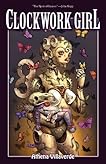
Clockwork GirlClockwork Girl by Athena Villaverde

My rating: 4 of 5 stars


Caterpillar Girl: A caterpillar girl named Cat is secretly in love with her best friend, a spider girl named Lilith. With their relationship survive her eventual metamorphosis?

As I've said in other reviews, risking my man-card in the process, my favorite bizarro stories are usually the love stories. This is one of the best bizarro love stories I've yet read. It struck a chord with this reader. Who hasn't been in love with someone but unable to even talk to them? The ending was surprising but has an eery beauty to it.

Clockwork Girl:
The Clockwork Girl tells the story of a toy clockwork girl named Pichi who first falls in love with her owner and then is discarded when her owner gets too old. That's about all I can say of the plot without giving too much away.

The Clockwork Girl is like something Peter S. Beagle might write if he was into Bizarro fiction. Pichi's innocence made the story for me. It would make a great Pixar movie if they'd let Tim Burton anywhere near the building.

Beehive Girl:
When you dance the tango with the Beehive Girl, you're dancing with death!

Okay, that might be a slight exaggeration. The Beehive Girl is a tale of the tango scene, where Maya, the beehive girl, is queen. If she chooses you as her partner, she's as sweet as honey until you screw up. Then you get stung.

Even though the title is Beehive Girl and the plot seemed to be leading in that direction, I wasn't sure the main character was going to end up dancing with Maya. The ending, much like the ending of Catepillar Girl, wasn't quite what I expected but was quite good none the less. Much like P.G. Wodehouse did with gold in The Clicking of Cuthbert, Athena Villaverde has made me care about the tango in Beehive Girl.

This is an easy four star collection from Athena Villaverde. Much like Starfish Girl, it's Bizarro fiction under a veneer of cuteness.


View all my reviews

Friday, January 27, 2012

The Quantum Thief

The Quantum Thief (The Quantum Thief Trilogy #1)The Quantum Thief by Hannu Rajaniemi

My rating: 5 of 5 stars


After being busted out of the Dilemma Prison by an Oortian warrior named Mieli, legendary master thief Jean Le Flambeur is taken to the Oubliette, one of the Moving Cities of Mars, and is tasked with the ultimate heist. Opposing him is a brilliant young detective named Isidore Beautrelet. But there is more to each man's quest than meets the eye...

My summary doesn't do the book justice. There are so many ideas crammed in it's slim 331 pages. Before Le Flambeur can even get started on his quest, he has to steal back his old memories. Isidore, on the other hand, has a lot of issues of his own, like his odd relationship with one of the tzaddikim, powerful vigiliantes who work to keep the Martians safe from unseen enemies, and an equally odd relationship with his girlfriend.

Before I get any deeper into this review, I have a few things to mention. I bought this book the day it became available and then let it sit on my shelves for almost nine months. The reason was pretty simple: all the reviews I read mentioned that Hannu Rajaniemi throws the reader into the deep end of the pool. He doesn't explain a lot of his concepts, leading the reader to decipher the meaning of words like 'blink, gevulot, quplink, exomemory, and many others, soley by context. Having read both John C. Wright's Golden Age trilogy and Gene Wolfe's Book of the New Sun in 2011, I was a little apprehensive. Should I have been?

No! While it takes a little getting used to, I felt The Quantum Thief was easier to understand than either of the earlier works I mentioned. It's written in a breezy style remniscent of Maurice LeBlanc's Arsene Lupin, a work that this one owes a great debt to. Not only is Jean Le Flambeur based on Lupin, Lupin is even mentioned in the text.

Where was I? Oh, yes. The world Rajanieme creates is a very interesting one. While the author used the Lupin tales as a blueprint, it feels like he fleshed out his creation with bits pilfered from books like Hyperion, The Golden Age, Neuromancer, and many others, welding them all together with his background in quantum physics. This is one of those books that has so many big ideas flying around you can hardly keep track of all of them. Hell, I'm already forgetting things I wanted to mention. Maybe I'll just list them.

1. Time is used as a currency. When you run out of time, you die and the Resurrection Men come for you. After a period of time with your consciousness inhabiting a robot body and doing routine maintenance on the City, you get a new body.
2. Tzaddikim patrol the streets, keeping the general population safe.
3. By 'blinking, you can recall anything that happened anywhere in the Oubliette using the exomemory. It's like the internet, only better and with slightly less pornography.
4. Privacy is a big deal. By using a gevulot, you control the flow of information to other people.
5. There's a glossary of terms used in The Quantum Thief on Wikipedia. It would have helped immensely if I'd had it when I started but probably would have made the read a less rewarding experience: http://en.wikipedia.org/wiki/Glossary_of...

The principle characters are an interesting bunch. I'd say the book approaches a number of ideas per page ratio comparable to one of China Mieville's works. It's primarily a heist tale but there's plenty of action. I sure wouldn't want to be in Miele's way. There's a point where sufficiently advanced technology is indistinguishable from magic. The Quantum Thief comes pretty close to that point on many occasions.

The ending met all my expectations, both in regard to actions and revelations about the overall setting. If I hadn't already known The Quantum Thief was the first in a trilogy (boo!), I would have been slightly disappointed.

While the Quantum Thief looks like a science fiction novel, it's really a heist story about a criminal and the man tasked with catching him. If you can handle being in the dark for part of the time, this is one hell of a read. I wouldn't say I like it as much as Hyperion but it's definitely WAAAAAAAY up there in my science fiction hierarchy.

Additional thought:
Hannu Rajaniemi looks a lot like Jason Bateman of Arrested Development fame. Look them up and see for yourself.


View all my reviews

Arsene Lupin, Gentleman-Thief!

Arsène Lupin, Gentleman-ThiefArsène Lupin, Gentleman-Thief by Maurice Leblanc

My rating: 4 of 5 stars


This is a collection of short stories featuring Arsene Lupin, Gentleman Thief.


The Arrest of Arsene Lupin: A trans-Atlantic cruise ship gets a message saying that Arsene Lupin is on board, with a recent forearm wound and going by the name R-. The message gets cut off and hysteria grips the ship. Everyone whose name begins with R is suspected of being Lupin.

The writing is good and there are only slight hints that it's been translated from French. The story was well done and I'm a little ashamed that I didn't see the reveal coming.

Arsene Lupin in Prison: Baron Cahorn gets a letter from Arsene Lupin saying that either he should box up some of his prize paintings for Lupin or Lupin will collect them himself in one week's time. But Lupin's in prison, isn't he?

Lupin in Prison was even better than the first story. Lupin's way of robbing Cahorn from within prison walls is both innovative and plausible. The relationship between Lupin and his nemesis, Detective Ganamard, looks to be the best part of future stories.

The Escape of Arsene Lupin: Lupin, still in the clink, continuously tells people he won't be attending his trial. The authorities intercept a message from an accomplice of his and try to catch him in a trap. Little do they know, Lupin has more than one trick up his sleeve.

As of this story, I am officially a Lupin fan. He's the anti-Holmes, a criminal genius who's still a likeable character. Speaking of Holmes...

Sherlock Holmes arrives too late Lupin's casing a castle under a false identity. He has to be quick with his burglary, however. Sherlock Holmes is on his way...

Usually, crossovers don't live up to expectations. I'd say this one is different. Both Lupin and Holmes are given their due and neither is made to look markedly inferior to the other. The mutual respect between the two is well done.

These are just a sampling of the Lupin adventures contained within. I recommend them to mystery fans, especially those who like their protagonists brash and witty. Arsene Lupin is clearly influenced by Sherlock Holmes but has things in common with P.G. Wodehouse's Psmith character, as well as superheroes like Batman. He plans for every eventuality. Where Holmes uses his intelligence for good, Lupin uses it for personal gain, governed by a somewhat noble code of ethics.

2012 Note: I'm reading The Quantum Thief by Hannu Rajaniemi. It's partly an sf homage to Lupin and brought back fond memories of reading this.


View all my reviews

Wednesday, January 25, 2012

The High Window

The High WindowThe High Window by Raymond Chandler

My rating: 3 of 5 stars


Philip Marlowe is hired to find the Brasher doubloon, a valuable gold coin stolen from its owner. Marlowe trails the owner's daughter in law, thinking she stole the coin. Marlowe's path leads him into a web of murder and black mail. Will Marlowe be able to find who stole the doubloon without winding up on the pile of corpses left in its wake?

As I continuously mention, noir fiction of this type agrees with me like a bottle of Mad Dog does a homeless man. The High Window, Raymond Chandler's third Philip Marlowe book, is no exception.

A wise man once said "No one reads Raymond Chandler for the plot." I agree with whomever that wizzened old sage was. Chandler never met a plot he couldn't overly complicate but The High Window is one of his more coherent ones. The search for a stolen doubloon sees multiple men dead and a wealthy family's secrets pulled out of the basement and thrown on the front lawn for all the neighbors to see.

Marlowe is Marlowe. As usual, much of the supporting cast exists mostly for Marlowe to bounce great lines off of and/or have sapping or shooting at him. The Bright family is a bunch of rotten apples one and all.

As I said before, this is one of Chandler's simpler plots but it's still a bit of a mess. It took me a little while to tip to the connection between the dentist and the missing coin. The black mail angle was well done. Chandler played his cards close to the vest, like always. "It just made me want to climb up the wall and gnaw my way across the ceiling." Marlowe used that line to describe a drink he took. That's how I felt about the plot sometimes.

It's no surprise by now that Chandler's prose is the star of the show. I mentioned in my review of Farewell, My Lovely, that Chandler's prose sometimes reminded me of a gritty P.G. Wodehouse. I've since learned that Chandler spent a lot of his early life in England so that's a little easier to understand now.

While it's my least favorite of the three Chandler books I've read so far, The High Window is still a great read, if for no other reason than to experience Raymond Chandler's prose. Not quite a four but it's an overflowing three star read.


View all my reviews